
Resistance spot welding electrodes: a practical guide
The electrode is the part of a resistance welder that touches the work. It carries the welding current into the joint, applies the force that holds the sheets together, and takes heat away once the weld is made. When the tip face grows or wears, the current spreads over a larger area and the weld weakens, so choosing, fitting and maintaining electrodes is as important as setting the machine.
Choose the material for the job
TSM supplies electrode material as round and square bar, with special sizes made to order:
- ZrCrCu (zirconium chromium copper): the material of our bend electrodes.
- CrCu (chromium copper): used for our two-point electrodes.
- BeCu (beryllium copper) and WCu (tungsten copper): also stocked as raw material.
- Tungsten and molybdenum: for welding highly conductive materials such as copper, in spot, roller, projection and upset welding.
See electrode raw material and tungsten and molybdenum electrodes.
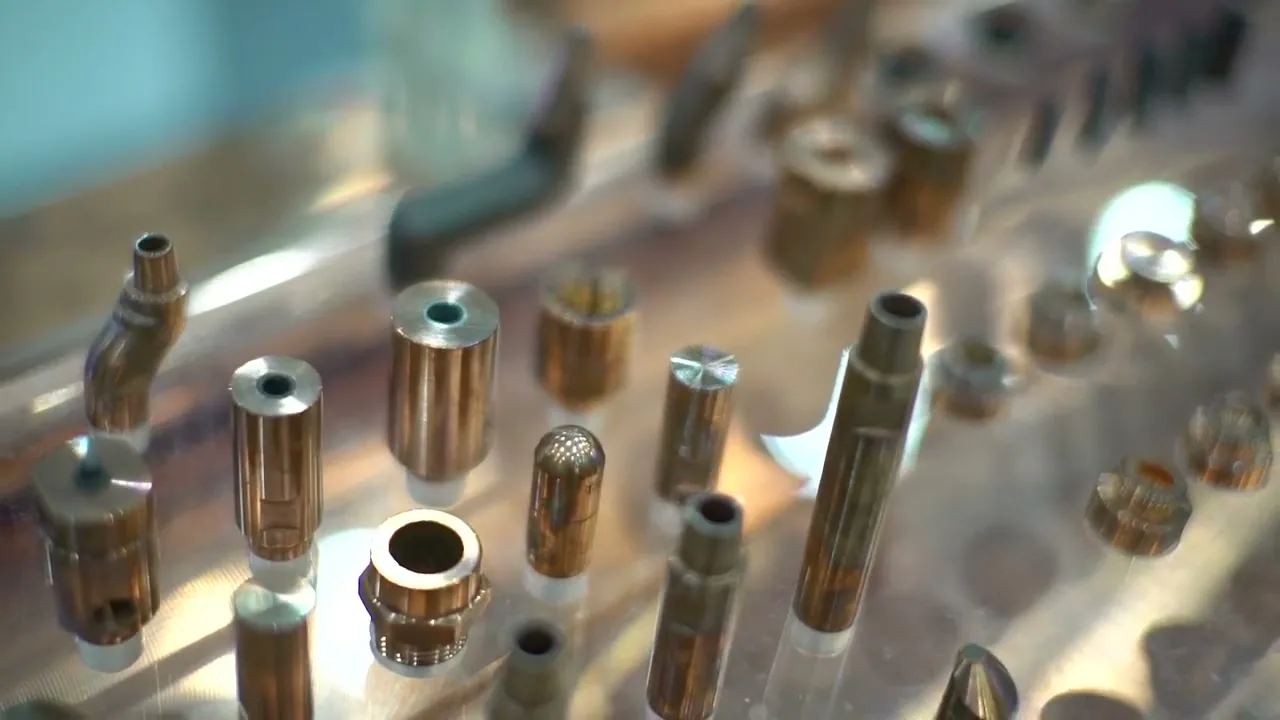
Cap tips, shanks and tapers
A cap tip sits on a shank and is held by a taper fit. Our standard cap tips come in C-12, C-13 and C-16 sizes, with straight and bend shanks to reach the joint. The taper must match on both parts: we make 1/10, 1/5 and MT#1 to MT#3 tapers, and supply taper ring and plug gauges and taper reamers to check and restore them.
Keep the tips dressed
A dressed tip keeps the contact face the size the weld settings expect. Our tip dressers cover two ranges:
| Model | Tip size | No-load speed | Weight |
|---|---|---|---|
| ETD-18F | 8 to 18 mm | 1,300 rpm | 1.65 kg |
| ETD-25F | 19 to 25 mm | 1,100 rpm | 1.68 kg |
Changing tips is quicker with the right tools: the tip remover (RO-13 and RO-16 series) and the tip opener (RR-13 and RR-16).
Starting settings
Our DC Inverter Welding Parameter sheet gives starting points by sheet thickness. For mild steel at Class A (best condition) it lists, for example:
| Sheet (mm) | Electrode d (mm) | Weld time (ms) | Force (lbf) | Current (A) | Fusion zone (mm) |
|---|---|---|---|---|---|
| 0.5 | 4.8 | 100 | 292 | 6,100 | 4.3 |
| 0.8 | 4.8 | 140 | 405 | 8,000 | 5.3 |
| 1.0 | 6.3 | 160 | 495 | 9,100 | 5.8 |
| 1.5 | 6.3 | 240 | 809 | 11,600 | 6.9 |
| 2.0 | 8.0 | 340 | 1,102 | 13,500 | 8.0 |
| 3.0 | 9.5 | 480 | 1,798 | 17,300 | 10.4 |
The same sheet gives Class B and Class C settings and a galvanised steel table. Treat every value as a starting point and confirm it with test welds on your own parts.
The Practical Welding Data Table goes further: spot, projection and seam welding for mild steel, carbon steel, stainless steel, zinc-coated sheet and aluminium alloys, with an electrode material selection table. The Hardness Value Conversion Table converts between HV, HRC, HB, HRA, HRB and tensile strength for carbon and alloy steels, following ASTM A 370.
All of them are free on our downloads page, together with the full TSM electrode catalogue.
Not sure which tip, shank or holder fits your gun? Send us the model or a drawing and we will match it.